
AI and Sentimentality

I was having a discussion with a “klezmer person” recently about the deluge of AI klezmer slop. All of the AI klezmer seems to have one thing in common- it is extremely sentimental, almost to the point of testing how much of it humans can tolerate before exploding.

These videos used to get very few views, but that is changing.

I said the stuff was probably fatal, in that it would choke off any competition just by sheer force. It tells people what they want to know before that infantile desire can be complicated, creating a vicious cycle of confirmation bias. And while we both agreed-“Well, that sucks”- I noted that there didn’t seem to be much discussion amongst musicians about what we might do in response to it or how to even think about it.
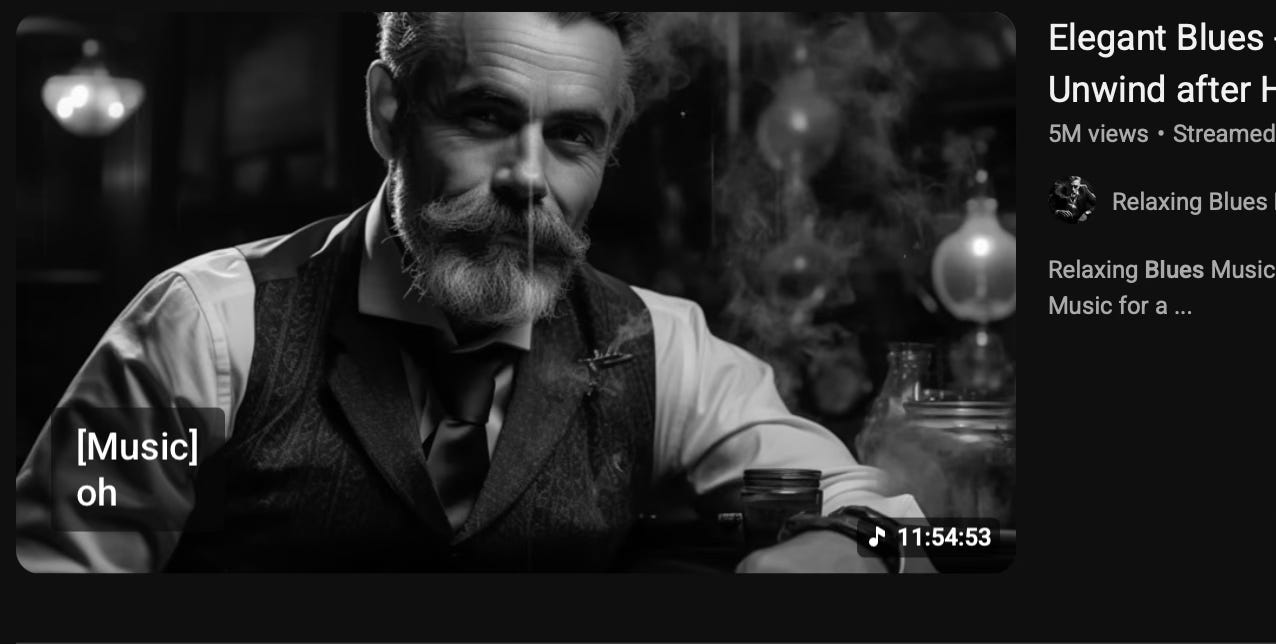
We’ve covered this ground before- In art, AI is essentially salon art (see archives) and in music, AI’s two dimensional sentimentality mirrors the overbearing myth of “resilience” that is now practically mandatory in our culture (see lament stuff in archives). As Farya Faraji notes in his excellent discussion of AI pseudo-trad music, the vocal style is that same everpresent “resilient” Babe you are a firework style we’ve been stuck with since the early 2000s (see Against Resilience). The only reason I’m re-posting it is to hopefully spark some enthusiasm for the idea that we, as artists and musicians, might be able to help each other form some practical ideas about how to think and what to do about this.
So these quotes below are meant to be useful as starting points in case anyone wants to think about responses to AI slop based on social, psychological or ethnic lines. I think I’ve posted most of these before in the context of kitsch, especially the Baldwin, but I’ve become convinced that kitsch is perhaps no longer a useful category, and these avoid that concept. There are many more that could be useful, but I’m aiming for simplicity so this doesn’t become merely an academic exercise. What would it look like to put these in practice in a classroom, or in a show?
Feel free to add some if you have any.
-
Sentimentality, the ostentatious parading of excessive and spurious emotion, is the mark of dishonesty...the wet eyes of the sentimentalist betray his aversion to experience, his fear of life, his arid heart; and it is always, therefore, the signal of secret and violent inhumanity, the mark of cruelty… Baldwin
The psychiatrist knows only too well how each of us becomes the helpless but not pitiable victim of his own sentiments. Sentimentality is the superstructure erected upon brutality. - Jung
The counterpart of sentimentality is, as we know, brutality. -Jung
I remember, anyway, church suppers and outings, and, later, after I left the church, rent and waistline parties where rage and sorrow sat in the darkness and did not stir, and we ate and drank and talked and laughed and danced and forgot all about “the man.” We had the liquor, the chicken, the music, and each other, and had no need to pretend to be what we were not.
Notice that this “not pretending” exactly what most AI music explicitly doesn’t do.
This is the freedom that one hears in some gospel songs, for example, and in jazz. In all jazz, and especially in the blues, there is something tart and ironic, authoritative and double-edged. White Americans seem to feel that happy songs are happy and sad songs are sad, and that, God help us, is exactly the way most white Americans sing them—sounding, in both cases, so helplessly, defenselessly fatuous that one dare not speculate on the temperature of the deep freeze from which issue their brave and sexless little voices. Only people who have been “down the line,” as the song puts it, know what this music is about. I think it was Big Bill Broonzy who used to sing “I Feel So Good,” a really joyful song about a man who is on his way to the railroad station to meet his girl. She’s coming home. It is the singer’s incredibly moving exuberance that makes one realize how leaden the time must have been while she was gone. There is no guarantee that she will stay this time, either, as the singer clearly knows, and, in fact, she has not yet actually arrived. Tonight, or tomorrow, or within the next five minutes, he may very well be singing “Lonesome in My Bedroom,” or insisting, “Ain’t we, ain’t we, going to make it all right? Well, if we don’t today, we will tomorrow night.”
See Took My Babe Away, Train Laments (1900-1910)
White Americans do not understand the depths out of which such an ironic tenacity comes, but they suspect that the force is sensual, and they are terrified of sensuality and do not any longer understand it. The word “sensual” is not intended to bring to mind quivering dusky maidens or priapic black studs. I am referring to something much simpler and much less fanciful. To be sensual, I think, is to respect and rejoice in the force of life, of life itself, and to be present in all that one does, from the effort of loving to the breaking of bread. It will be a great day for America, incidentally, when we begin to eat bread again, instead of the blasphemous and tasteless foam rubber that we have substituted for it. And I am not being frivolous now, either. Something very sinister happens to the people of a country when they begin to distrust their own reactions as deeply as they do here, and become as joyless as they have become.
It is this individual uncertainty on the part of white American men and women, this inability to renew themselves at the fountain of their own lives, that makes the discussion, let alone elucidation, of any conundrum—that is, any reality—so supremely difficult. The person who distrusts himself has no touchstone for reality—for this touchstone can be only oneself.
Such a person interposes between himself and reality nothing less than a labyrinth of attitudes. And these attitudes, furthermore, though the person is usually unaware of it (is unaware of so much!), are historical and public attitudes. They do not relate to the present any more than they relate to the person. Therefore, whatever white people do not know about Negroes reveals, precisely and inexorably, what they do not know about themselves. - Baldwin from Fire Next Time